
The men’s 6 Nations is over, far more exciting than usual. Now we can look forward to an even more eventful women’s version.
All six squads will be shaking off memories good and bad of last autumn’s World Cup. This series presents a new beginning. On a distant horizon lies the 2029 RWC.
The Big Unknowns
How far can individual nations improve, especially the two who have new bosses in charge, France and Scotland?
Let’s look at each, in reverse order of their 2025 finishing spots.
Wales
48 players had a two-day training session at the end of February. If that was indeed the first time they assembled, then it emphasises the distance they have to travel. Other nations donned their boots in mid-January.
Sean Lynn has had to watch progress in the Celtic Challenge with a hopeful eye. He knows he must establish a squad that can dominate opposition for a full 80 minutes.
That is something they have failed to do for a while.
It’s good news that the two CC franchises, Brython and Gwalia, have come closer to the long-time leaders, the two Irish sides, than in the past. It remains to be seen which of the uncapped players can make the big leap to international level.
To my mind, Lynn needs to find forwards who can really put opposing packs under duress. Tyrone Holmes becomes the latest addition to the coaching staff, charged with looking after their affairs.
Out behind, Lleucu George needs stiff competition for the 10 shirt. She rarely reproduces her Gloucester-Hartpury form for her nation. The same goes for other PWR backs like Hannah Dallavalle and Jas Joyce.
Alysha Butchers returns to the fray. The best of good luck to her.
Schedule: they start with a big one: against Scotland at the Principality Stadium, with an early evening kick-off. Ticket sales are highly promising.
Scotland
Their outlook is still clouded by concerns over contracts and the way the SRU has handled them.
Fancy words like “enhanced” don’t reassure.
Sione Fukofuka assembled over 50 players for an initial training session, casting his net wide. He needs to ensure he has at least two players competing for each position. The candidates may be there, but is the quality too?
Schedule: the big date is the game against England at Murrayfield, one of the important firsts the 2026 competition has to offer. (The previous match there was a last-minute rearrangement.)
There are fine players in the squad, but not enough, to my mind, where it matters, up front.
Italy
The Azzurri have beaten England’s men’s team for the first time! Can the Azzurre repeat the medicine?
I fear not.
For all the energy and skill they possess, they are hamstrung by the passive approach of the FIR.
At a basic level, they still have to play at their Parma ground, capacity around 5,000. Compare that with the Allianz, the Aviva or Scottish Gas Murrayfield.
More centrally, the squad is not given the backing other national sides enjoy in the 21st century; there are no superstars, with their faces splashed over every media form. TV is mostly absent, and other forms of publicity sadly absent.
Fabio Roselli has one year of 6N experience to rest on. But the lack of growth in player numbers means he will have to rely mainly on the established players to produce results.
He is hunting for a more aggressive approach to play. Just as important will be stamina; too many matches slip away in the closing quarter.
I’m afraid the Azzurre will need a star player more reliable and consistent than Beatrice Rigoni to lead them to the heights.
Ireland
They are surely the one nation who can hope to dislodge England and France from their perches.
I for one would dearly love to see that happen, and I possess not a drop of Irish blood.
Scott Bemand included ten uncapped players in his first training squad. Truth to tell, he needs them less than some of his counterparts.
The two Irish CC franchises, Clovers and Wolfhounds, sit at ease atop the 6-team table, so most of a likely first-choice team have a number of successful results behind them.
They started practising early, on 12 January, that is, right in the middle of the CC tournament.
They have a new captain in charge, Erin King.
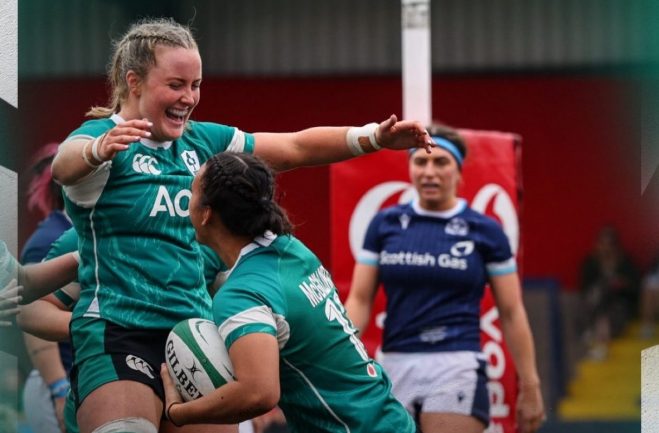
Schedule: their big day comes at the Aviva Dublin in Round 5 when they take on Scotland. As with their Round 1 game against England at the Allianz, this will beat all existing attendance records.
It’s a fine gesture for the IRFU to offer Galway as a venue, a rare visit to west Ireland. Inevitably disappointed voices cry: “What about Cork?”
You can’t please everyone all the time.
I really hope the Green Wave can get close to claiming two big scalps.
France
This is where things grow even more fascinating.
How far can François Ratier have achieved his aims by 11 April? He wants to see more discipline (a past record of innumerable penalties) and the basics of the game solidly in place.
Is that possible with the unpredictable French?
Yes, especially if he finds room for some of the highly talented age-group players. He has been watching Elite 2 club matches as well as the ten elite AXA clubs. Few promising youngsters are likely to miss out.
Ratier’s very young squad is built with 2029 firmly in mind.
Les Bleues were only one point away from equalling England away last year, but their RWC showing was a grave disappointment.
Schedule: they start this year in Grenoble against Italy. That should give them the psychological boost they need to achieve great things. They have been training assiduously at Marcoussis.
They have three home games, two away.
Like so many of their opponents they need to find a pack that can hold the English at bay. Once that is achieved, they have the skills to do the job.
But it’s eight long years since they last got the better of the Anglaises. At least any young players involved won’t have that stigma disfiguring them.
And they should have a more encouraging voice to listen to than in recent years.
England
The Red Roses are in an unusual position: they are the No 1 ranked side as usual but also World Champions, far less usual.
So it’s been John Mitchell’s task to bring them down to earth again. Sixteen weeks of PWR matches will have helped too, coming up against hosts of test players from other nations.
There are known absences: Emily Scarratt and Abby Dow much to be regretted; Abby Ward and Lark Atkin-Davies for happy reasons. Highly talented replacements queue up to take their place.
Do we want to see England win for an eighth time? If I say no, I’m likely to be dragged to the stocks and have bad eggs thrown at me. Or perhaps Tyburn tree awaits.
Still, a change of trophy winners would do the old championship a deal of good.


