
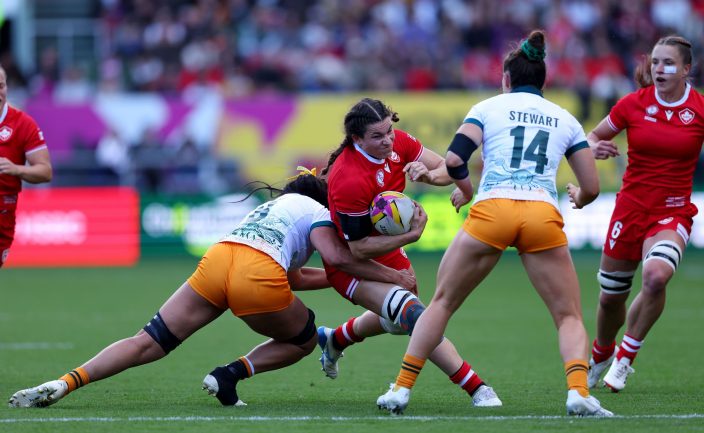
The tenth World Cup was a massive success. Now comes the question, how will national unions react to its effects?
None of the options will be easily gained, whether they be increased funding, better support for players or a lasting response from the public, sponsors and the media.
Let’s take a glance at a few of the nations concerned.
Canada
At the start of the month Rugby Canada proudly announced that it had passed its funding target of $1 million ($1.06m). Excellent. (We should not forget that RC had already poured $2.6m into the cause.) And the players came so close to a first trophy win in England.
This money allows a new Maple Leafs squad to add a training visit to Chula Vista, the USA’s Olympic training centre in California, in May, then a further session in Perth Ontario before two tests against South Africa.
South Africa
Mention of the Women Boks brings us to one of the most fruitful leaps forward. They had long been the Cinderellas in a nation devoted to the oval ball. Now the SARFU is supporting their efforts more fittingly, the sky’s the limit.
One concerning feature – common to several countries – is the dominance of a single club, here the Bulls Daisies. (Gloucester-Hartpury aren’t the only hat-trick winners.) While they can ensure the bulk of a successful Boks team, the game needs strengthening right across the Republic.
France
The FFR has set as a major target increasing the number of licensed players to 100,000 by 2033 – quite an undertaking. But this is the effect the tenth RWC had on youngsters across the world.
Les Bleues are one of many squads to say goodbye to retiring players, while also welcoming a new head coach. Those changes alone add excitement to the 2026 Six Nations.
There is massive talent coming through the junior ranks. Can they help to overcome France’s extraordinary but unwelcome record at World Cups – two 4th places and six 3rds?
Wales
On the surface the news from Cardiff is heartening: the introduction of two new pro-squads, increased funding for Brython and Gwalia in the Celtic Challenge and the establishment of new pathways.
Elinor Snowsill, now Player Development Lead, is confident. She sees a generation of really talented players coming through.
Welsh critics are less convinced. For a start: where is the money coming from? Then, is it reasonable to expect players to return from English clubs to their homeland and a far less secure future? Are there enough players of the right quality to make this a going concern? The lack of a scouting system is but one of a number of unexplained gaps.
The overall view is that the programme announced by WRU lacks coherence and clarity.
The Celtic Challenge
One of its major weaknesses had been the unequal matching of player resources. The IRFU filled its two teams with test players; the SRU and the WRU didn’t.
At least the new season will culminate in semi-finals and a final, to add more bite to proceedings.
As things stand at present, it’s hard to see Ireland being toppled from their position as leading rivals for second place in the 2026 Six Nations. They were upset at failing to overcome France in the RWC quarter finals. They lost only 13-18.
New Zealand
The Black Ferns came face to face with reality when Canada took them apart in a memorable semi-final.
Some of their weaknesses have been recognised, notably the lack of top-quality rugby through the year. This helps to explain the appearance of five Ferns in England’s PWR.
Above all, they, like some other nations, will benefit enormously from the new WXV Global Series. They will play ten tests in 2026, including four at home.
There are concerns that the rescheduling of Super Aupiki till later in the year will have harmful effects. For one, the Farah Palmer Cup will now come after it, denying selectors the chance to observe developing talent before selecting a first training squad.
Strangely, there is also a concern about players burn-out, but I’ll leave that to the people concerned.
Australia
Rugby Australia faces a unique problem: it will play host to the eleventh RWC in four years time. If it comes close to emulating the tenth, it will have achieved miracles.
Its position has not been eased by reports of an actual decrease in funding of the Wallaroos. If true, that would make them the first of the sixteen nations to suffer such a fate.
And the union’s position is hardly clarified when it says the prime target is to win the 2029 RWC.
We don’t need reminding that Australia is a prime sporting nation, but the Wallaroos have been unable to shake off their rating as a Tier 2 nation. They were walloped 5-46 by Canada in the quarters, and their overall record against the top Nations is sadly dismal: just two wins against France.
Like NZ they will benefit immensely from the Global Series, playing ten tests across 2026.
Given that hosting role, eyes will be directed at their progress in attracting new young players to the game – against the siren calls from cricket, rugby league and elsewhere.
Sam Needs, the new interim head coach, will have his hands full.
England
Just a brief note.
The RFU’s decision to withdraw 7s contracts, starting in 2020, played a huge role in the Red Roses’ success of recent years, culminating in a third RWC trophy. Unlike every other nation, they didn’t have to worry about integrating 7s players into a new 15s squad. They had long since grown used to the longer format.
Odd thoughts
The last two gold-medal winners both performed in front of their own fans. A hat-trick of such wins looks most improbable.
Inevitably it will take time for answers to come to many of the problems I have outlined here; and there are plenty of others.
We can only hope that the huge surge of interest and goodwill created in England two months ago can continue its tidal effect.


