
The two words come from the same source, both involve a thousand.
But in rugby it’s curious how different our approach is to these measurements in different parts of the field.
A loud voice behind me in the stand bellows: “For goodness’ sake, get on with the game!
Yes, we all prefer fast, open play. “Too much whistle!”
But let’s take a look at a few discrepancies. Here are three examples where the Laws are regularly overlooked (and nobody cares?)
1. The thrower’s feet at the line-out. They are supposed to be outside the field of play (the touchline is outside), but we often see the thrower start well across the line; even taking one or two steps to act as a launching-pad.
The classic offender was Gaelle Mignot, who would finish up nearly close enough to shake hands with the prop at the front of the line.
The person nearest the misdemeanour, the AR, never bothers with such irrelevant details.
Who cares? Get on with the game.
2. The kick-off. The ball must travel 10 metres forward (unless played first by a opponent). Time and again the kick is delivered from well within the opponents’ half.
Who minds? Until we get to those agonising millimetres close to the tryline. Then we do.
3. The one that bugs me most, the penalty kick.
More frequently it’s the kick to touch. The referee indicates the mark, then turns away to explain her decision to the offending side.
Again and again the kicker will treat the mark as the starting-point of her run-up, not the delivery point. It’s a rare kicker who steps back to ensure she obeys the indication given.
The crowd applauds a wonderful 50-metre touch-finder. The pack rumbles over for another try. But if the kick had been taken from the correct spot?
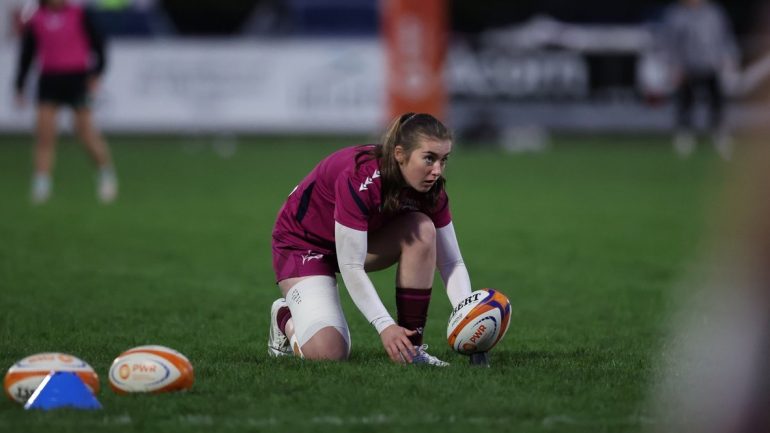
Far worse, the kick at goal. Once more the referee gives the mark, then turns away to explain her decision or chat to the TMO.
The kicker crouches to place the tee, but at the spot indicated? Very rarely, and it’s an even rarer AR who will intervene. She’s too busy running around behind the posts. The ball will be placed ahead of the mark.
The unscrupulous kicker will then need to realign the ball and tee. Magically they finish up even closer to the posts. Take another look at replays of big matches to spot the proof.
The crowd holds it breath. The ball creeps over the bar from 50 metres out; applause rings round the ground. A world cup is won by two points!
And if the ball had been placed at the point indicated?
“Get on with the game!”
A last, more familiar discrepancy, the two traditional set-pieces, scrum and line-out. Both have caused the law-makers endless problems across the decades.
The scrum involves player-safety to a much greater degree. Hence recent adjustments that allow the ball to be inserted far from the straight line that used to be required.
And is the No 9 standing the correct distance away?
In stark contrast the line-out throw may still be whistled when it’s a millimetre skewhiff, even in a 40 mph cross-wind. A team loses its advantage and the rest of the pack pat the disconsolate thrower on the back.
“Get on with game!”
This is where the best referees earn their corn. They can ensure that the vital decisions are correct and carried out with the minimum of fuss. Common sense prevails.
Sara Cox had just retired from the test arena. Who is lining up to take her place from within England to adjudicate games with the same clear, even-handed approach?


