
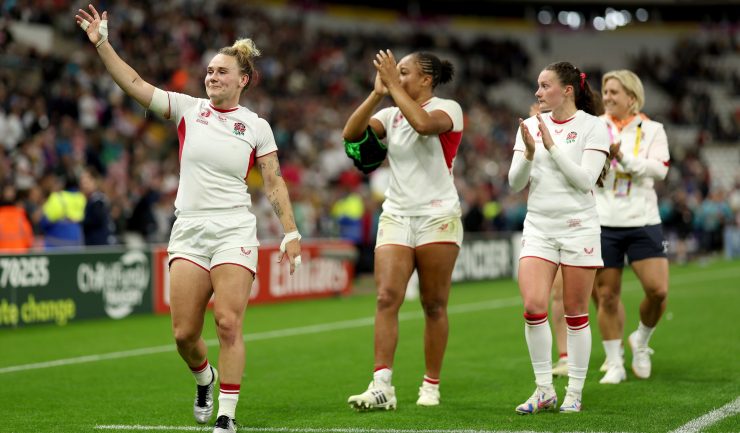
John Mitchell has announced his first England training squad very early, almost exactly three months before kick-off.
He’s making use of the five-week break in the PWR schedule which even allowed certain players off the leash to compete in the Celtic Challenge.
The large total of 47 players offers us three complete teams, plus two more to run the lines.
Unsurprisingly all 30 of the remaining RWC winners are listed. We must lament the absence of Emily Scarratt and Abby Dow, but we can’t have everything.
To fill out the squad Mitchell and his staff have selected no fewer than eleven uncapped players. As we survey the complete list, we may wonder what earthly chance these youngsters have of appearing in the 2026 Six Nations. But it’s called Forward Planning. Many of them have already worn the white shirt at U18 then U20 level.
No age-limit?
At the same time it’s a salutary warning to older players that time doesn’t stand still.
The most senior are Mo Hunt and Marlie Packer. They will be 37 and 36 respectively at the start of the 6N. Marlie may already consider herself at best as second choice No. 7 behind Sadia Kabeya, but Mo?
Lucy Packer, Ella Wyrwas and Flo Robinson are snapping at her heels, but if only two 9s are selected, that will leave more disappointed characters standing around.
Maternity matters
It’s fascinating to see Lark Atkin-Davies’ name included. Rather like Abbie Ward a few seasons ago, she is kept on the strength, with due precautions laid on. A chance for her to polish her refereeing skills?
6N prospects
It’s far too early to indulge in detailed previews, but it’s difficult to see England being knocked off their perch.
France may well present a different challenge under an innovative coach, and it’s their turn to play host. But they have yet to prove they can build a 23 to outlast a Red Roses squad.
Young and not so young
Alongside the eleven newcomers we find nine players with fewer than ten caps. Their chances of preferment are greater, but has competition ever been so tough?
Trailfinders
TF can feel pleased with themselves. Alongside the two RWC winners, Meg Jones and Abi Burton, we find no fewer than four youngsters, all forwards: Jasmine Adonri, Annabel Meta, Hayley Jones and Haidee Head.
It’s that last name that intrigues me. Head was Queensland Reds’ Rookie of the Year in 2023. I’ve been listening to a fascinating hour-long discussion between David Pembroke and Libby Nankievell on all matters women’s rugby, including the RWC, the Wallaroos and prospects for the eleventh RWC in Oz. Have a hunt for rugbyunitypod.substack.com
One criticism they level at RA is the lack of the aforementioned forward planning. They knew Jo Yapp was returning to England but failed to ensure a replacement was lined up. Sam Needs is the interim boss across 2026, and it’s only three years to the next RWC. The Wallaroos can’t afford to let a talented player like Head slip through their fingers. Promising as she may be, England aren’t short of alternatives. Australia, short of cash and enjoying not an atom of goodwill from Rugby League, need all the strength they can muster.
Club distribution
As we must expect, the spread of talent across the squad of 47 neatly reflects PWR standings. Gloucester-Hartpury are the only club to boast double figures; Leicester Tigers the only one to muster none. Once again I have to query the processes by which the PWR board examined Leicester’s planning and expectation of success.
Curtain up!
The squad has already assembled at Pennyhill Park, Surrey.
Then, beaten by only a short head, Scott Bemand has just published 37 names of a first Irish training squad.
Can they continue their splendid advance?


